
Return To Course Overview

You don’t need to be a painter to understand (and teach) how to control paints and brushes.
In this lesson, you’re going to discover how to help your artists control their paint so they enjoy it more, and learn a few tips for managing the painting process and the tools that go with it.
Some artists are afraid of paint. Pencils are much more controllable, so safety is found in drawing. Drawing has more friction. Paint seems just too slippery and goopy.
One of the most profound things I’ve found in all my years of teaching art, is that artists enjoy every medium, once they feel confident in it. Most artists will do lots of different kinds of work when they know they have control and know what to expect.
So I like to say, “painters need to draw, and drawers need to paint.”
Acrylics and watercolors are used in our lessons. Oils are saved for advanced artists, because most of the basics can be done with acrylics, which are much easier to use and clean up, and have good pigments that are not highly toxic. Oils also often use very toxic thinners and additives. Acrylics are also less expensive, so there are great reasons to use it for all of the Foundations lessons.
Pigments are covered in the next lesson, and are integral to a good experience with all color painting media. We use the same 10 pigments for both watercolor and acrylic.
Make your own watercolors
Every watercolor lesson can be done with our acrylics, watered down to create a workable and inexpensive version of watercolors. Feel free to get a set of the same pigments in student grade watercolors though (like the Cottman brand). The sets in pans are ok to use, but our color theory will not work with them. You usually have no control over the pigments in these sets, and often have no idea even what the pigments are.
Getting just the right amount
Like goldilocks needs just the right temperature for her porridge, paint needs just the right amount; not too much, and not too little.
When an artist doesn’t use enough paint, their work has a thin look to it, and they often scrub their brush on the canvas or paper, or add too much water. Both methods come from the student trying to make their paints go further; trying to conserve resources – normally an admirable goal.
However, you cannot conserve your paint so well that none is left over. All painters must come to terms with the fact that you will have to throw paint away at the end of the painting session. You’ll never paint well if you don’t.
When you have an artist who uses too much acrylic paint, it is not really a big problem unless they’re purposely playing with it. One thing to look out for though, is the big squeeze. That’s when squeezing it out is so much fun that you get a palette full of large chocolate kiss-sized blobs of paint. If most of these are being thrown in the trash at the end of the session, it can feel pretty wasteful.
For a very young artist, this is easy to fix. Just limit how much paint they get by controlling it yourself. You can also warm up with oil pastels or markers, and get the more playful art-making out of their system.
Gently Direct Artists Towards Balance In Paint Amounts.
Be careful to not scold or be overly corrective about too much or not enough paint. This is a lesson unto itself, and spending a little bit for extra paint early on, is a great trade-off for a lifetime of loving art.
For artists who consistently use too much paint, ask them at the end of a session, how they can solve the problem of throwing so much paint away. Then remind them of their own solution at the beginning of the next session. This may take more than a few reminders, so be patient. It’s worth it.
It is actually harder to get a skimpy painter to use more paint, so it may take a lot of permission-granting, and time, to move them towards this goal. Again, it’s worth the effort because lush paint is wonderful on a canvas.
With acrylics, tell a painter who is too conservative, to paint like a rich person. Help them feel like they’ll never run out of paints.
With watercolors tell a painter who is too frugal, that the water is the paint. Water is free! All you do is color the water with the pigments. The fact is, that you can’t paint in watercolor unless you make a ton of paint. Never, ever, ever, let yourself run out of watercolor while painting one area.
Remember this, almost every negative-seeming behavior will usually be a stage that artists will need to experience, before moving themselves out of it. Some stages are very short. Some need quite a while. Have patience!
Too much paint is only a significant problem when an artist is having trouble controlling it. An artist who is uncomfortable with paint will often use too much at first, and that makes them lose control. Then they may reject paints altogether. There are ways you can help them learn to control the medium.
Here are some tips:
- Having too much paint on the brush can be a problem. Twirl your brush on the surface of the palette pad to get the blobs of paint off of it before working on a painting.
- Bend the bristles to gain more control. If you’ve ever cut-in the edges with a house-painting brush, you have done this.
- Point the tip of the brush towards the edge of what you’re painting to get a good edge. You can’t get a clean edge underneath the bristles. You have to turn the brush and/or the canvas, in order to point the tip at all your edges.
- A round (cylindrical) brush with a pointy tip gives the most control. Smaller is better unless you’re filling in a larger area.
- Move the brush at least a little bit, when placing paint on a surface. Stamping with the brush is not a very attractive technique. Dabs need at least a bit of stroke to look good.
Brush tips
Brushes should not be cleaned while painting, after every color use. Only clean when you’re changing from a cool color to a warm color, or the other way around. Even then, sometimes it’s good to just wipe a brush off. This allows the colors intermingle on the painting, making sure that they’re not too harsh or different from each other. If you cook, you know a pot of sauce is better after the flavors have mingled while simmering, or even better, after sitting overnight in the fridge. Not cleaning your brush too often accomplishes a similar thing for a painting.
Wipe – Wash – Wipe
Wiping as much paint off of a brush as you can, is essential before cleaning it in a water jar. This keeps your water clean for much longer, and also keeps paints out of your plumbing. We use this to remember: WWW, for Wipe/Wash/Wipe.
Cleaning a brush in a water tub will not fully clean it.
I repeat, cleaning in the water tub will not clean all of the paint from a brush.
The brushes will feel and look clean, but they’re not, because there is paint in the cleaning water. Once dried, the film of paint left on each bristle will be waterproof. Three or four layers of paint film will thoroughly ruin a good brush. This means it’s essential to do a second cleaning at the end of the painting session/lesson. We call this a “super-wash.” Always ask your artists if they have Super-Washed their brushes before putting them away. Otherwise, you will have crunchy brushes the next time you paint. You do not want crunchy brushes.
Another cleaning tip is to use a disposable palette pad. The paper sheets in these pads are coated with plastic on the top side. The entire pad is glued on the top and the bottom, so that it’s stable, and works more like a slab of wood, until you’re finished. Then you separate the top sheet and peel it off. Fold the leftover paints up into the sheet and throw it in the trash. You have nothing to wash, and no paints go down the drain.
Where do you start painting?
I am asked this quite often. My answer is always, “wherever you want”. The exception to this is if you want depth, and you’re trying to paint fairly realistically. In that case, you want to start at the most distant, and work your way towards the closest one step at a time. In a landscape, that means working from top to bottom.
How to paint stress-free
This is simple to say, but surprisingly hard for artists to believe: You can paint over anything.
The myth that everything you do is supposed to look great, is what intimidates so many artists. They cannot imagine painting over their art, because they think it is somehow shameful. But you can overcome this by explaining that painting over part of a painting is exactly like erasing and re-drawing with pencil on paper. With painting, you just don’t have to do the erasing part first. Most artists don’t have the same problem with erasing.
Keep in mind that children younger than 8 years old, have a completely different cognitive approach to their work. They cannot conceive of erasing, or painting over something, because self-improvement is not a concept they understand yet. Everything is awesome, and they just want to make more work. They have a hard time with any kind of re-drawing. If you drew it already, why would you draw it again?
Paint may be a difficult medium to control, but you can really help your young artist to manage it using the methods in this lesson.

Here is a typical setup for two students 4 to 7 years old, using tempera paints. Washable tempera is not as bright or enjoyable to use as regular tempera.

Here is a setup for two students age 8 or older, using acrylic paints. A watercolor setup is similar, but you need two buckets of water. One is for making and lightening paints and needs to be kept clean. All the wet things are on the dominant hand side, so artists don’t dribble onto their painting reaching across it.
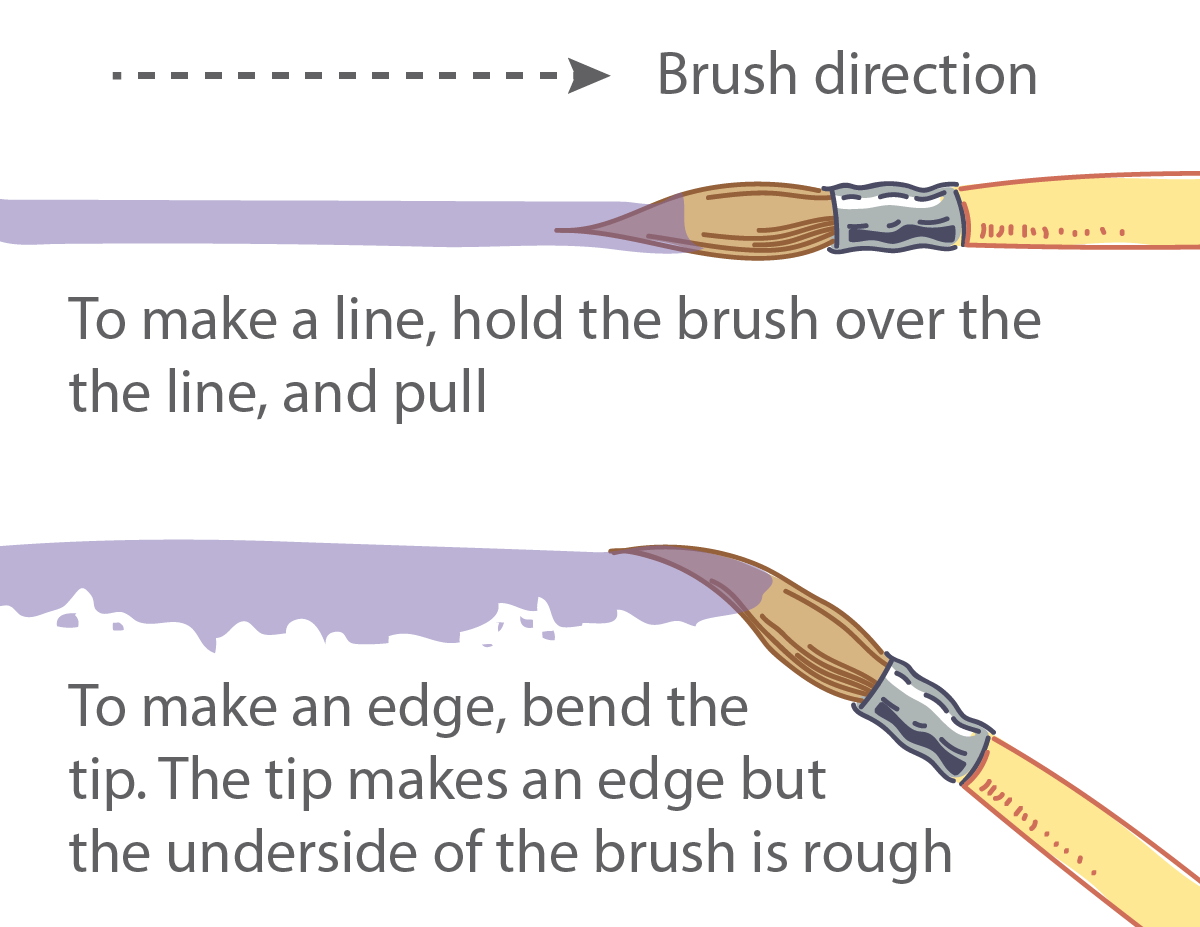
How to paint with clean edges.

Popular brush types. A filbert is like a flat brush (flat is also called “bright”) but with rounded corners. This helps artists avoid visible squared-off brush strokes on their paintings that can result from using a flat brush.