

One of our members has a great question
And yet I do not want to constrict…. especially in a sketchbook. Your ideas please?”
Gillian
Washington, DC
Dennas Responds
More than one kind of paper – for multiple purposes
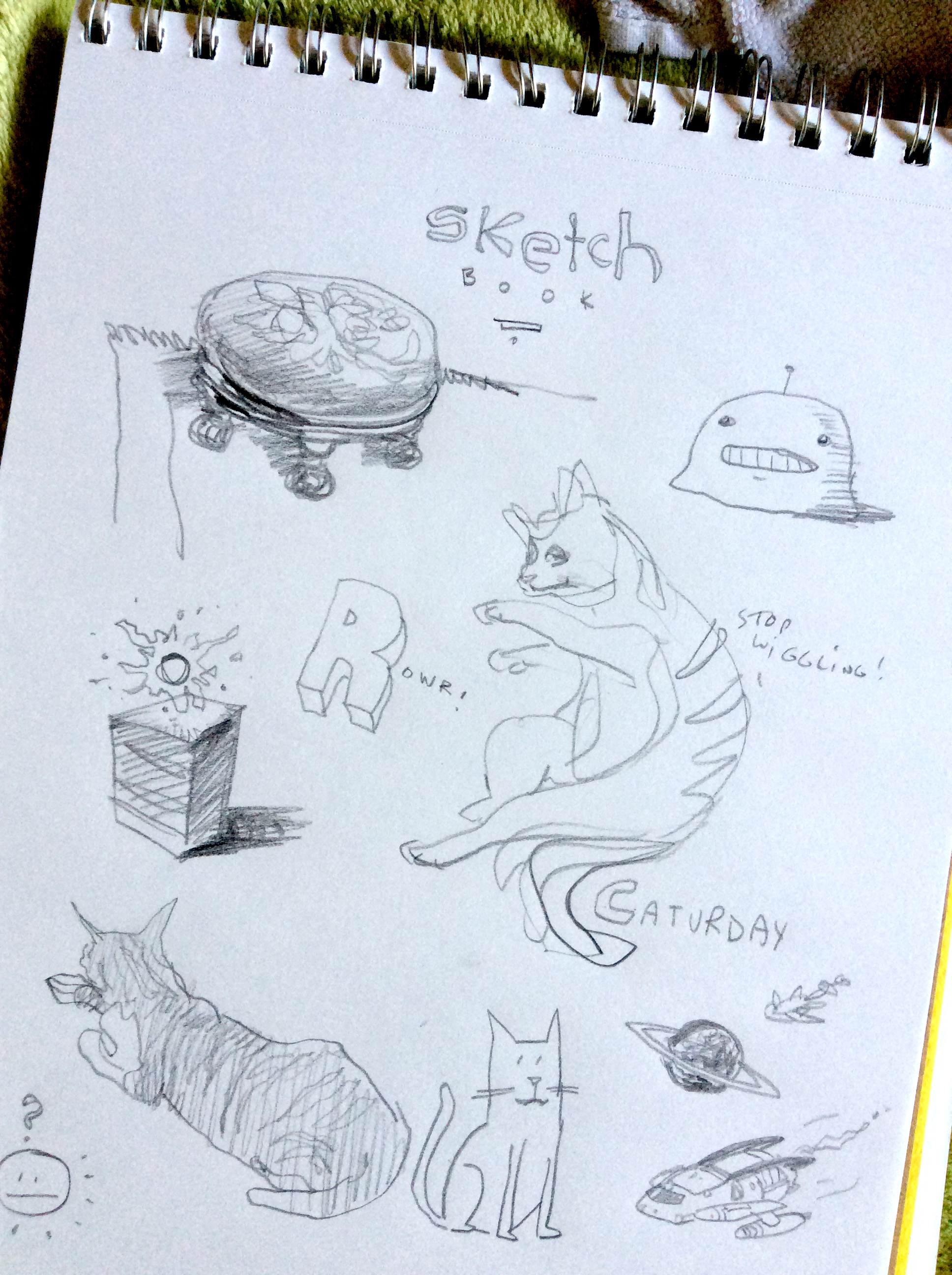
Show students examples of other artist’s sketchbooks so they know what clusters of smaller drawings on one page looks like. Here’s a page from my sketchbook, showing things around my room and random ideas I had one day.
Tap the image to open in a viewer.
For all other sketching, use different papers.
Nothing beats copy paper for warmups, especially if there is freedom to explore, which tends to produce more of the kind of work students don’t care about afterwards. We have regular size copy paper, and also the large 11 x 17″ ledger size. It is excellent for markers, especially if you get the heavier weight and really bright white versions. We get our regular size at Costco, and for the larger paper we go to Staples or Office Depot. We also buy the same sizes in card stock for when you’re making heavy duty artwork. The cover stock at Staples is a not a very good a surface, but the card stock has a smooth hard surface, similar to bristol board. It takes wet media better.
If you rely on parents to donate to your school or purchase sketch pads, they should be happy to get these papers for you. It might be difficult for them to find the larger sizes, so you might have to go get that yourself, unless you have one of those special super-parents.
For older students I also like to encourage carrying a mobile sketch book: a very small sketchbook that they can carry everywhere. Fill the pages with as many live sketches as possible.
Don’t ever say, “Free Draw” again.
We talk frequently about making each blank paper worth something. It may turn out to be a learner, but don’t give up after the first line is drawn. Keep after it and envision your finished work. Even a learner adds to your ability, so nothing is ever a waste of time, even if you hate the resulting artwork.
Don’t ever say that a paper is ruined, or a student made a mistake. Instead, call it a learner. It’s ok for the student to throw it away or even tear it up, but emphasize the value of learning from every single attempt. It’s called practice!
Vanquish the small, centered drawings
It’s frustrating to see giant sheets of quality drawing paper with a small rough sketch in the very center.
Divide to conquer
You might also show some images of artist’s sketch books from the internet. Just make sure you select them before hand. Active searching with children present is NOT a great idea, even with safe-search on and filters. Pinterest is a great source too.
If you have other suggestions please share in the comments.
Unlimited paper is important, because the world needs happy artists!
Dennas